
A maintenance team at a food processing plant swaps out its bronze bushings every three months—scheduled grease intervals, downtime, labor. A neighboring facility running the same conveyor speed and load switched to DU bushings two years ago and hasn't touched them since. Same application, very different outcomes. The difference comes down to understanding how each bushing type actually works, and matching that to what your equipment actually demands.
Both DU bushings and bronze bushings are described as "self-lubricating," but the mechanisms behind that label are quite different. Getting the distinction right before specifying can save significant maintenance cost, reduce unplanned downtime, and extend component service life.
How Each Bushing Type Actually Lubricates
DU bushings rely on a solid lubricant transfer film. The bearing surface is lined with PTFE (polytetrafluoroethylene), which deposits a thin, low-friction film onto the mating shaft during initial operation. Once that transfer film is established, friction stays consistently low—even during stop-start cycles, oscillating motion, or periods of no movement. No external oil or grease is required at any point.
Bronze bushings lubricate through a different mechanism depending on their construction. Oil-impregnated sintered bronze bushings store lubricant in a network of microscopic pores—typically 18–25% by volume—and release it to the shaft surface when heat and pressure build up during rotation. Solid bronze bushings with graphite inlays work differently again: the graphite plugs create a dry, continuous lubricating surface that releases under friction, functioning well in high-temperature environments where oil would degrade or burn off.
The practical implication is straightforward: DU bushings perform reliably across intermittent, low-speed, and oscillating motions where hydrodynamic oil films never fully develop. Bronze bushings, particularly sintered types, generally perform better under sustained rotation at moderate speeds, where a stable oil film can form and replenish itself. Understanding this distinction is the foundation of every correct selection decision.
DU Bushings: Structure, Strengths, and Limits
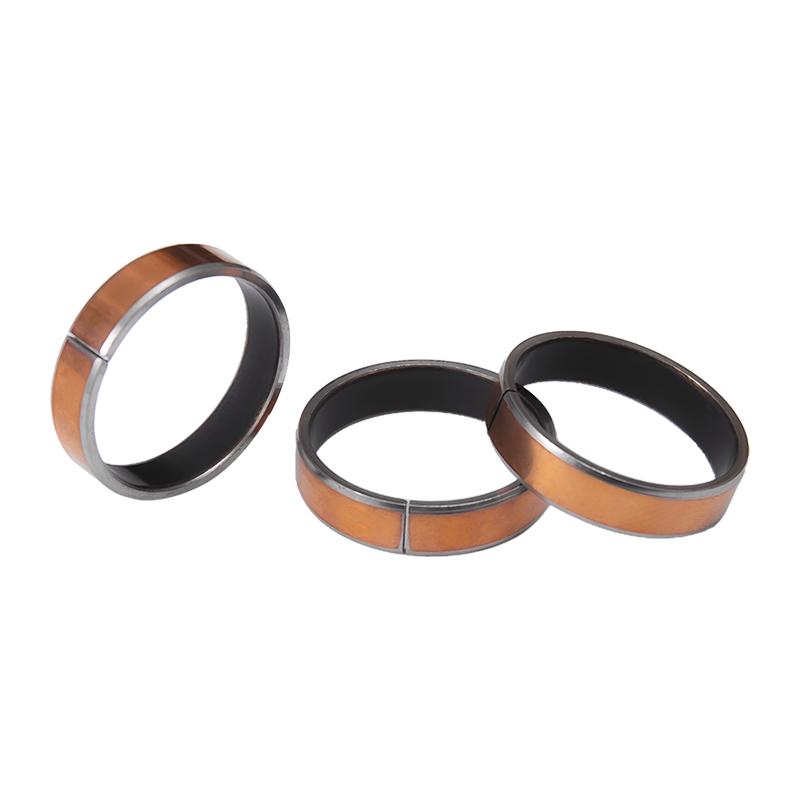
A standard DU bushing is built in three layers. The outer layer is a steel backing that provides dimensional stability and press-fit retention in the housing bore. Bonded to it is a porous sintered bronze interlayer, which creates mechanical adhesion between the steel and the bearing surface. The inner sliding surface is a PTFE-based composite—often blended with lead, fiber, or other fillers—that delivers the actual low-friction interface with the shaft.
The performance numbers for DU bushings are competitive. Friction coefficients typically fall between 0.04 and 0.12, with the lower end achieved under light loads and smooth shaft surfaces. Maximum static load capacity reaches 250 MPa in many standard grades, and operating temperatures generally span −40°C to +280°C, making them suitable for both cold-environment equipment and moderately elevated thermal conditions.
Their strongest argument is maintenance elimination. In applications where lubrication access is difficult—pivot points on agricultural implements, linkage pins on construction equipment, hinges on industrial gates—DU bushings remove the maintenance requirement entirely. Service life under appropriate load and speed conditions routinely exceeds 10,000 hours without intervention.
The limits are equally important to understand. DU bushings are not suited to continuous high-speed rotation, where frictional heat can exceed the PTFE layer's thermal limit. They also have a finite wear layer—once the PTFE composite is consumed, the bearing must be replaced. And they are more sensitive to shaft surface finish than bronze alternatives; a shaft roughness above Ra 0.4–0.8 µm will accelerate wear of the PTFE layer measurably.
For maintenance-free performance in oscillating, reciprocating, or slow-rotating applications, see DU-type composite self-lubricating bearings with PTFE overlay from Huazhou's HZ-10 series.
Bronze Bushings: Three Types, Three Use Cases
Grouping all bronze bushings into a single category understates the differences between them. There are three distinct constructions, each with its own performance profile.
Sintered (oil-impregnated) bronze bushings are made by powder metallurgy—compressed and sintered bronze powder creates a porous matrix that is then vacuum-impregnated with oil. The result is a self-contained lubrication reservoir. These bushings perform well under continuous rotation at moderate speeds, are economical to produce, and require no external lubrication in clean, stable environments. Their limitation is that the oil reservoir eventually depletes under heavy loads or high temperatures, and the lubrication system fails silently—wear accelerates without obvious warning.
Solid bronze sleeves—wrought or cast—offer the highest mechanical strength in the bronze bushing family. They carry higher radial and axial loads than sintered types, resist shock loads without deformation, and are rebuildable: a worn bore can be reamed back to tolerance or replaced with an oversized shaft. These are the preferred choice in heavy equipment where loads are severe and service access for periodic relubrication is feasible. Explore single-metal solid copper sleeve bushings for high-load continuous operation in Huazhou's HZ-090 range.
Graphite-inlaid copper sleeves bridge the gap between metal durability and dry lubrication. Graphite plugs are pressed into precision-machined holes in a solid bronze body, distributing solid lubricant across the bearing surface. This construction handles temperatures up to 400°C or higher—well beyond what any oil or PTFE system can manage—while maintaining the structural strength of solid bronze. They are standard in steel plant equipment, die-casting machines, glass manufacturing lines, and other applications where thermal loads are extreme. See graphite-inlaid copper sleeve bushings for high-temperature and heavy-load environments in Huazhou's HZ-JDB range.
Head-to-Head: Key Performance Parameters
| Parameter | DU Bushing (PTFE composite) | Sintered Bronze Bushing | Graphite Copper Sleeve |
|---|---|---|---|
| Friction Coefficient | 0.04 – 0.12 (dry) | 0.08 – 0.20 (oil-film) | 0.10 – 0.20 (dry) |
| Max Static Load | Up to 250 MPa | Moderate (porous structure limits peak load) | High (solid metal body) |
| Max Operating Temp. | −40°C to +280°C | Up to ~120°C (oil degradation limit) | Up to 400°C+ |
| Lubrication Required | None | None (reservoir) / periodic top-up at high load | None |
| Speed Suitability | Low to medium; oscillating/reciprocating | Low to medium continuous rotation | Low speed, high load |
| Corrosion Resistance | Good (steel backing: risk in wet environments) | Good (bronze inherently corrosion-resistant) | Good (bronze body) |
| Shock Load Tolerance | Moderate | Moderate (porous structure can crack) | High (solid construction) |
| Typical Industries | Automotive, hydraulics, agricultural machinery | Light machinery, pumps, general industry | Steel, glass, die-casting, heavy presses |
Total Cost of Ownership: The Number That Actually Matters
Purchase price is the least useful metric for bushing selection. A DU bushing may cost 20–40% more per unit than a sintered bronze equivalent of the same size. Over a three-year operating period in a difficult-access application, that premium is typically recovered within the first maintenance cycle.
The real cost comparison has three components. Material cost is only one of them. Lubrication cost—grease, oil, labor, and the logistics of scheduled maintenance intervals—adds up quickly in large installations. A plant running 200 grease-lubricated pivot points on a quarterly schedule may spend more on lubrication labor alone than on the bushings themselves. Downtime cost is often the largest variable: an unplanned equipment stop caused by a failed or dry bushing in a production line carries costs that dwarf any component price difference.
The calculation shifts depending on the application. In a simple, accessible machine with a clear maintenance schedule and moderate loads, sintered bronze bushings offer an economical and proven solution. In high-cycle equipment, difficult-access locations, food-grade environments where contamination from lubricant is a compliance issue, or anywhere that unplanned downtime carries serious cost, DU bushings' maintenance-free operation typically justifies the higher unit price within the first year of operation.
Graphite copper sleeves occupy a different economic space entirely—they are specified when no other option can survive the thermal or load environment, and their cost is evaluated against the alternative of far more frequent replacement with any other bushing type.
Application Scenarios: Which to Choose and When
| Application / Condition | Recommended Type | Key Reason |
|---|---|---|
| Agricultural machinery (pins, linkages) | DU bushing | Oscillating motion, difficult grease access, dusty environment |
| Construction equipment (excavator arms, loaders) | DU bushing or graphite copper sleeve | High load, slow oscillation, outdoor exposure |
| Food & pharmaceutical processing equipment | DU bushing or engineering plastic | No lubricant contamination, washdown resistance |
| Light industrial pumps and motors (continuous rotation) | Sintered bronze bushing | Sustained rotation, oil film stable, cost-effective |
| Steel plant equipment, die-casting machines | Graphite copper sleeve | Extreme temperature, no oil/PTFE can survive |
| Automotive chassis and suspension components | DU bushing | High-cycle oscillation, maintenance-free requirement |
| Hydraulic cylinder guide rings and rod seals | DU bushing | Reciprocating motion, compact cross-section required |
| Heavy press and stamping equipment | Graphite copper sleeve or solid bronze | High radial load, shock resistance priority |
When Neither Standard Option Fits
Some operating conditions fall outside what DU or standard bronze bushings handle well. Very slow oscillating motion under high load—think crane slewing rings, bridge bearings, or press guide plates—creates boundary lubrication conditions where neither PTFE transfer films nor sintered oil reservoirs function optimally. For these cases, boundary-lubricated bearings for low-speed oscillating applications are specifically engineered with surface geometries and lubricant systems suited to this regime.
When the priority is maximum load capacity with the corrosion resistance of bronze and the dimensional stability of steel, bimetal composite bearings combining steel backing with a bronze sliding layer deliver a combination that neither material achieves alone. The steel provides structural rigidity; the bronze running surface handles the tribological demands.
In food processing, chemical handling, marine, or other environments where metal corrosion is a persistent concern and weight reduction matters, engineering plastic bearings for corrosion-resistant or food-grade applications offer a fully non-metallic alternative with excellent chemical resistance and inherent self-lubrication.
The right bushing for any application is the one whose lubrication mechanism, load capacity, temperature range, and maintenance profile match the actual operating conditions—not the one that was used last time. When the operating conditions are clearly defined, the selection is usually straightforward. The difficulty arises when conditions are assumed rather than measured. Shaft surface finish, actual load cycles, peak temperature at the bearing surface, and maintenance access all matter more than nominal specifications, and all are worth confirming before placing an order.